
"Learning from Ukraine. Lessons in Resistance"
Acceptance speech by Prof. Dr. Karl Schlögel at the award ceremony for the 2025 Peace Prize of the German Book Trade
Yesterday, Kurt Schlögel was awarded the Peace Prize of the German Book Trade at Frankfurt's Pauluskirche. This is the highest honor that exists in Germany. I know Kurt Schlögel from "Café Kyiv," the major event in support of Ukraine that the Konrad Adenauer Foundation organizes annually in Berlin. We participated together in a panel discussion on the relationship between religion and the state in Russia. At the time, I didn't even know what an extraordinary personality I had next to me. But I sensed it in his comments.
What Schlögel says should be read and considered by the whole world. It is a prophetic voice that should be heard if we care about the future. We must act today, before it is too late. Otherwise, we will end up in a situation similar to that before the Second World War.
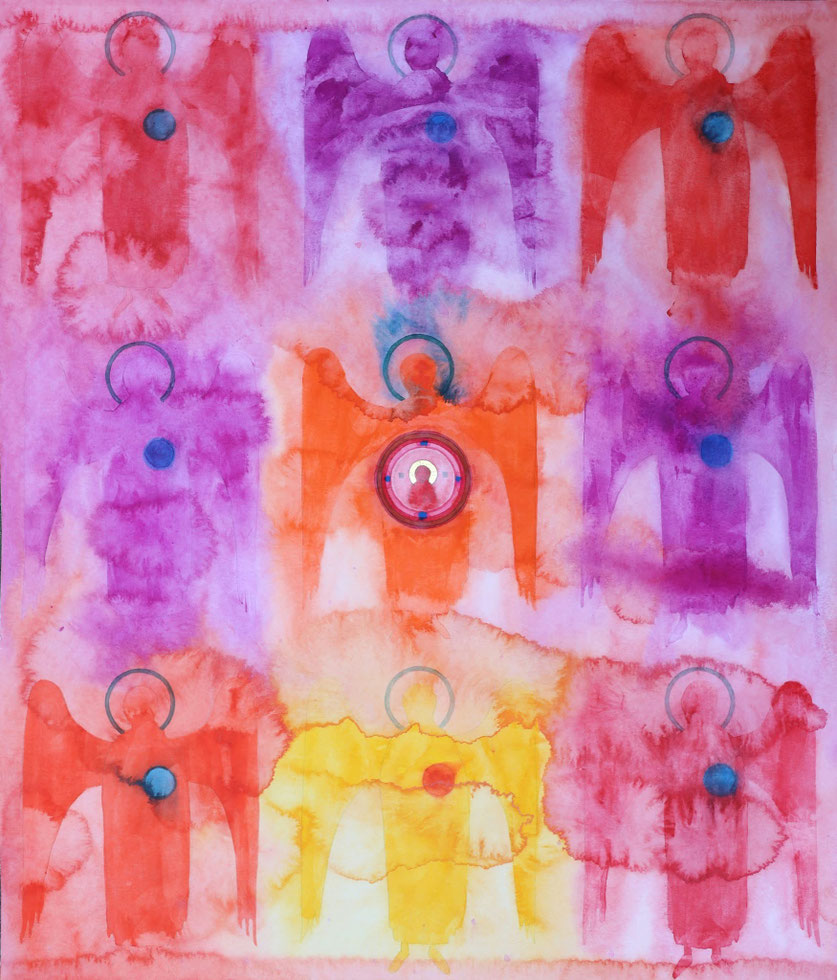
Image by Danylo Movchan: "The Cathedral of the Archangel Michael." It reminds us that the Archangel Michael watches over us with his heavenly hosts, as does Christ, the true ruler of the world.
Ladies and gentlemen, Mr. Mayor, I would like to thank the German Publishers and Booksellers Association for this prestigious award, for the very touching words, Ms. Schmidt-Friderichs, the members of the jury, my publisher, my long-time editor, and the translators who ensured that the books were published and reached their readers. I would like to express my heartfelt thanks to Katja Petrowskaja, who spoke better than I could about what has preoccupied me throughout my life. Thank you very much! It is particularly important to me that this award gives me the opportunity to speak at this historically significant place, not only in the 75th calendar year since the Peace Prize was established, but at a time when, in view of the new world disorder, we are becoming painfully aware of the limits of our own judgment. The most monstrous thing is happening: Before our very eyes, Ukrainian cities are being bombarded by Russian missiles day after day, night after night, and Europe seems unable or unwilling to protect them. We were stunned to witness the murderous pogrom carried out by Hamas on October 7, 2023, and the transformation of Gaza into a battlefield with thousands upon thousands of civilian casualties. The world takes little notice of the apocalyptic scenarios of civil war in Sudan. But where, if not here in Frankfurt's Paulskirche, is the place to talk about ways out of war and take Walter Benjamin's statement seriously: "Those who want peace must talk about war." Or, in an older version: "Si vis pacem, para bellum."
Looking back at the Peace Prize awards – which is easy to do with a click on its website – one might at first glance get the impression that everything has been said on the subject of war and peace. The speeches read like a chronicle of the intellectual situation in postwar Germany: at first, in the early years, everything was still overshadowed by the Second World War, which had just ended, and the catastrophe that had spread from Germany across the world; the venue for the award ceremony itself had just been rebuilt from the ruins. Looking back, it becomes clear that the following decades were by no means an idyllic time of peaceful coexistence, but rather a period of Cold War, a time of balance of terror, of the ever-present possibility of nuclear self-destruction. The fall of the Iron Curtain and the end of the Cold War did not bring about the end of history in Europe, but rather a period in which, with the disappearance of systemic antagonism, the reasons for the great military conflict between the two superpowers also seemed to have become obsolete, while the Yugoslav Wars – as keen observers had already noted – already pointed to an end to the post-war period, which came to an end with the Russian occupation of Crimea in the spring of 2014 and – definitively – with the invasion of Russian troops on February 24, 2022, opening the door to a new pre-war period.
Research into the origins of wars and the complicated paths to peace – silencing the guns, ending the killing, disempowering the aggressor, perhaps reaching a peace treaty that can then be followed by reconciliation – offers an infinitely rich source of illustrative material for what diplomacy can and cannot achieve, but it does not provide recipes that can be applied for all time, because history does not repeat itself. And then one realizes that, despite all the knowledge, despite all the experience of previous generations, one has to start all over again from scratch, and that, in deep perplexity, one lacks the words to describe what is happening before our eyes. The terms we use to describe the new circumstances are inadequate. We are lost for words to describe what is happening. This is more than just a lack of terminology or literary talent; it is the collapse of the horizon of experience in which we grew up and where everything we have gathered in the course of our lives seems to be called into question, devalued, even lying in ruins. I couldn't imagine that Russia would once again fall back into times that in many ways resemble the practices of Stalinism, the study of which I had devoted years of my life to; I couldn't imagine an America that I had come to know as a student, in which fear of an authoritarian regime could once again spread. The idea that something could go wrong in the Federal Republic of Germany was completely foreign to me. Above all, I couldn't imagine that war, which for me was something I only knew from television or documentaries, could become a reality in my immediate neighborhood. But that is what happened. And it seems to me that now it is our turn—if I may speak in the collective singular—the generation accustomed to a seemingly peaceful time and spoiled by peace, to think everything through again from the beginning, a kind of review and examination of a generation that has been incredibly lucky and is now finding it incredibly difficult to saying goodbye and preparing for war in Europe and everything that goes with it.
What a liberating feeling it was to work our way out of the confines of the divided world of the Cold War and move across the demarcation line between East and West or under the Iron Curtain. For me, a person who had no family ties to Eastern Europe, but whose father had been at war since September 1, 1939, spending most of his time on the Eastern Front and in Ukraine, this was the case very early on. I learned very early on that beyond the division of Europe into East and West, into socialism and capitalism, there was another, a third, which was not identical to either, the lost center of Europe. This marked the beginning of a journey of discovery into a region that was not of particular interest in post-war West Germany at the time, or was mostly only viewed from the perspective of observing the enemy. As always, biographical coincidences play a decisive role: Russian lessons at a Bavarian boarding school, the atmosphere of thaw and peaceful coexistence in the 1960s – first Yevgeny Yevtushenko's poem Babi Yar and Boris Pasternak's novel Doctor Zhivago, but above all the lasting impressions of early trips to Prague and the former Soviet Union. It was thanks to these trips that I realized that Central and Eastern Europe were not just a matter of reading and academic education, but had something to do with the people, landscapes, and historical sites that I was to study, long before Milan Kundera's famous 1983 essay "Un Occident kidnappé ou La tragédie de l'Europe centrale": the atmosphere of the Prague Spring, the encounters and friendships with dissidents and emigrants, and the idea that the opposition movements in East and West had to find each other across the Wall, perhaps even in a bridge between intellectuals and workers. The mental map of Europe had already shifted before the fall of the great border. In dissident circles in Budapest, Warsaw, Berlin, and in Moscow kitchens, people discussed what would soon lead to the revolutions in Eastern Europe. It was an exciting time of conspiracy across borders, new readings, and the discovery of connections that created a new cultural space beyond the dichotomy of the divided world. A historical space of tremendous linguistic and cultural diversity, lost in war, genocide, and expulsion, opened up. People had always been on the move in the deadly zone between Hitler's and Stalin's empires, always moving in a space of double experience where, as they learned, there was no escape, no possibility of flight, a place of total helplessness.
The exploration of this space and the realization of its history were soon followed by the transformation of the political map, which, with the dissolution of the Soviet Union, did not stop at the borders of the last multi-ethnic empire. However, there was still a long way to go before Ukraine achieved complete independence and freedom. It took the Maidan Revolution and a war to finally bring Ukraine out of the margins of a narrow, Western-centric perception. It ceased to be terra incognita, a blank spot on the map. Through the screens, the news reports, the refugees who came to us, it became present to us, a large and beautiful country, a Europe in miniature, connected to the world by thousands upon thousands of threads: the thousand-year-old Kyiv, Kharkiv, a metropolis of European modernity, Odessa, from whose grand staircase down to the harbor one could look out over the entire 20th century, Lviv, Leopolis, Lwów, Lwow, Lemberg, more than just "Little Vienna," a cultural source for the entire continent. Ukraine as a prism of all European experiences in the "century of extremes": the scene of revolutions, civil war, and world wars, the Holodomor and the Holocaust, and, after decades of struggle, finally independence and freedom.
But then came Russia's occupation of Crimea. More than ten years ago, returning from Kharkiv, Donetsk, Mariupol, and Odessa, I wrote: "We don't know how the struggle for Ukraine will end; whether it will stand up to Russian aggression or whether it will be brought to its knees, whether the Europeans, the West, will defend it or abandon it; whether the European Union will hold together or fall apart. Only one thing is certain: Ukraine will never again disappear from the map in our minds." Putin's Russia is determined to wipe independent and free Ukraine off the map of Europe. Putin has openly declared this and has been proving day after day since then that he is serious about it. No words can describe the images of destruction. There is no cruelty that his troops have not committed. Nothing and no one has been spared from becoming a target for drones and missiles: marketplaces, residential areas, museums, hospitals, port facilities, train stations. Cities that were in the process of getting back on their feet—new airports, transport routes, hotels—are being bombed back into ruin. Cities are becoming hunting grounds for drones. The direct hit by the missile is followed by a direct hit on the rescue team. The industrial giants of socialist construction are reduced to rubble and ashes, as are churches, monasteries, and sanatoriums. What was once the Ukrainian Ruhr region no longer exists. If the country cannot be conquered, then at least it must be destroyed, made uninhabitable. A new term is making the rounds: urbicide. Deserted villages of the 21st century, blown-up dams and bridges, flooded landscapes, black earth fields burned and contaminated for generations, ethnic cleansing and the abduction of tens of thousands of children, the occupied territories as a large camp under the direction of warlords and criminals. The disaster that Putin's Russia has brought upon Ukraine has many names: imperialism, revisionism, mafia state, fascism, Raschism. His crimes are documented and stored in an infinite number of images in real time, and the names of the perpetrators—whether on the front lines, in the torture chambers, in the propaganda and command centers—will certainly be found.
It is astonishing how long it took Germany to realize what it was dealing with in Putin's Russia. Whatever was at play—historical path dependency, cultural affinities, nostalgia and sentimentality, economic interests, even corruption—it is a broad field for historical clarification and a reappraisal that spares no one. There were many who understood Russia, but too few who understood anything about Russia. Otherwise, they would have explained to us what was coming and that the categories used to describe Putin's empire were more the result of wishful thinking and gullibility than an admission that we were no match for this embodiment of evil—whatever term may yet be developed for it. How much easier and more convenient it was to blame NATO or the collective West: to this day, the search for a deeper meaning in Putin's politics has not come to rest. The following are mentioned: humiliation of the former superpower, fears of encirclement, need for security, struggle for recognition. This corresponds to the idea that misunderstandings can be cleared up and deals negotiated in argumentative discourse with him. However, Putin has refuted the idea that he would adhere to arguments or even rules of procedure from the outset. He simply overturned the table at which negotiations and discussions were supposed to take place according to predetermined rules and brilliantly declared rule-breaking to be the norm long before the term "disruption" came into circulation. He was and is the master of escalation dominance, the well-calculated intensification of conflicts, including the calculated breach of the nuclear taboo. Fear is his most important weapon, and his true talent lies in the " " management of fear. To this day, he considers himself the undisputed master of the process.
But not everything has to go according to his plan – the blitzkrieg against Ukraine, the capture of the capital, the victory parade on Khreschatyk in Kyiv, the encirclement of Kharkiv. Things turned out differently. Since he is making little progress on the front despite hundreds of thousands of dead and wounded, he is targeting the defenseless civilian population. His slogan is simple: "We will destroy you wherever you are, you have no chance except to surrender." Diplomacy is merely a tool to gain time, which he believes is working in his favor. The masterminds around him say it openly: "We will break the backbone of you Europeans." Is what I am saying Russophobia? It is part of the repertoire of intimidation rhetoric to defame criticism of Putin's regime as slander against Russia. As someone who has been enamored with Russian culture since his youth and who has spent his entire life promoting it, this does not affect me. It pains me greatly to see friends and colleagues in danger and driven into exile today. The instrumentalization of the prestige of Russian culture certainly plays a major role in the enforcement of Putin's imperial ambitions—Russkij Mir, the Russian world that knows no borders, as soft power. Of course, the rhetoric of intimidation and moral blackmail also includes defaming the Ukrainian leadership as Nazis and casting suspicion on the Germans as Nazis. The German Armed Forces are stigmatized as the successor to the Wehrmacht, while the Russian war against Ukraine is falsely portrayed as a continuation of the Great Patriotic War against fascism. All the crimes Russia has committed are summarily blamed on the Ukrainians – from the shooting down of flight MH 17 to the murders on the streets of Bucha. As absurd as this propaganda may seem, it is not without effect, especially in Germany, which for well-known reasons is still unsure of itself and therefore vulnerable. Compared to this, the propaganda of the Soviet era seems outdated and downright harmless. This is no longer about the contrast between black and white, about the distinction between truth and lies, but about dissolving the distinction between true and false itself, according to the motto: Everything is equally true, everything is equally false, thus destroying the basis of all judgment. It targets the domestic audience, seeking to create enemy stereotypes and fears of encirclement, but it also targets the public outside the Russian world. There is nothing that cannot be brought into play to undermine the credibility and self-confidence of Western societies. It is not difficult to find out where open societies are most vulnerable and easiest to hit – and where the forces are that can be exploited. Even the capacity for self-criticism and self-doubt, the greatest achievement of open societies, is used to undermine stability and self-confidence. Russia then praises itself as the bastion of a unique and in every respect superior civilization. Europe and the West, or what has been understood as such, are derided as weak and decadent, their time having passed. This voice is not without echo in a situation where Spengler's Decline of the West is once again in vogue. Taken together, all of this has an effect. The war that Russia has brought back to Europe is not only being waged by military means, but also as a war for hearts and minds, with moods, fears, resentments, nostalgia, or as a tempting offer to return to business as usual.
It is difficult to adjust to the new situation, the regrouping of forces and alliances in the world. It means saying goodbye to a world that has begun to disintegrate. Gone is the certainty of being able to rely on America, as we have known it since Alexis de Tocqueville's "De la démocratie en Amérique" or from great American literature, the country that I have remembered since my first visit as a land of freedom from fear and free speech. This America is now no longer valid. Europe is now confronted not only with the phenomenon of Putinism, but also with an American president who is throwing all notions of the silent functioning of checks and balances and alliances out the window and forcing us to rethink all the coordinates we thought were secure. Europe, left alone and entirely on its own in a situation where everything is open. In this situation, I began to reread the old texts in which, in the 1930s, the most clairvoyant minds tried to make sense of what was brewing in Central Europe. Once again, I returned to the analyses and writings composed in exile, whether in Paris, New York, or Weimar on the Pacific: Ernst Fraenkel's The Dual State, Franz Neumann's Behemoth, Theodor W. Adorno and Max Horkheimer's Dialectic of Enlightenment, or later, with Stalinism already in view, Hannah Arendt's The Origins of Totalitarianism. But however prescient and accurate these analyses were, we must now, at this turning point in history, set out on our own journey to grasp the novelty and danger of today's situation in our own words. Taking note of the lessons from Ukraine is helpful, indeed indispensable, for this.
No one is more interested in peace than the Ukrainians. They know that an aggressor who is determined to do anything cannot be stopped with words. They are realists who cannot afford to have any illusions. Because they do not want to be victims, they are fighting back. They are prepared for anything. They are fighting for their children, for their families, for their state; they are even prepared to die for their country. What elsewhere are only television images is a direct experience for them. The defense on the front lines would be nothing without the army of volunteers behind it. They have survived the winter and have braved the nightly terror of drones and missiles for weeks, even months. Yesterday they may have been IT experts, today they are piloting drones. The festive dresses that women wear when they go to the theater or a concert demonstrate an attitude that cannot be taken away, even in a state of emergency, and the club is the place where young people draw strength to continue the resistance. In a world that has become post-heroic, they are heroes without making a fuss about it. They keep the transport system running and thus hold their country together. The wailing of sirens is background noise in their everyday lives, not just a test alarm. They have learned how drone strikes differ from ballistic missile strikes. They help us prepare for the time after the turning point. They teach us that national defense has nothing to do with militarism. Soldiers, and especially female soldiers, are respected because everyone knows that they are doing their duty and what they are prepared to do.
The citizens of Ukraine teach us that what is happening is not called the Ukraine conflict, but war. They help us understand who we are dealing with: a regime that wants to destroy Ukraine as an independent state and hates Europe. They show us that accommodating the aggressor only increases its appetite for more and that appeasement does not lead to peace, but paves the way for war. Because they are on the front line, they know more than we do in the still safe hinterland. Because they are at the mercy of a superior enemy, they have to be faster and smarter than him. Ukrainians, who are under general suspicion of nationalism, show us that patriotism does not have to be outdated in the 21st century. They are ahead of us in terms of military technology because they were forced to fight at a time when we could still afford to debate questions of eternal peace. They have developed their own weapons, which were withheld from them due to hesitation or fear. They are the mirror in which we see ourselves and which reminds us of what Europe once stood for and why it is worth defending. They call out to us: "Do not be afraid," not because they are not afraid, but because they have overcome their fear. Their writers do their utmost to express what others far away cannot find the words for. They have carried the Ukrainian language out into the world and achieved a miracle of literature. Their poets speak with deadly seriousness; some have even paid for it with their lives. Their president is a man who expects his compatriots to face the truth, even though he knows how bitter it is. They are well versed in the behavioral principles of resistance and are teaching Europeans what to expect if they do not finally prepare for the worst. They have learned from experience that in threatening situations, decisions are made overnight that in peaceful times would be postponed indefinitely. Stoic composure is a luxury they can only afford again once the war is over. Enduring, persevering, despite unspeakable exhaustion—that is the revolution of dignity in permanence. It is to them that we owe our peace, and they pay a price that cannot be calculated in numbers.
It is they and all people of good will who deserve our thanks first and foremost. And it is to them that we extend our greetings from this place – from Frankfurt's Paulskirche, the site of the German unity and freedom movement, a hotspot of the European Spring of Nations of yesteryear. It is a greeting to the defenders of a free Ukraine, to the men and women who continue to do their work despite everything, who take their children to school in Kyiv despite swarms of drones, to the residents of Kyiv who remain in the metro station, to the train drivers who steer their trains punctually from Ivano-Frankivsk to Kharkiv.
As unlikely as it may sound, we Europeans can learn from Ukraine: to be fearless and brave, and perhaps also to learn how to win.
Kommentar schreiben